Tuesday, March 16, 2010

Culture Shock

To many migration is considered to be nothing bad, but people in Sudan have experienced the worse migration. In the documentary "The Lost Boys" you follow a group of Sudanese boys who undergo a forced migration to a refugee camp in Kenya then to America. This is also known as stepped migration. The Sudanese were forced to move because of a civil war in Sudan. This war was started due to the unfair of share of power between the Muslim north and the Christian south. The lost boys walked all the way from Sudan to seek asylum in Kenya and Ethiopia. Through this they experienced many things. They were attacked by wildlife, starved and had to endure the hot sun of Africa. One of their most painful experiences was crossing the River Gilo between Ethiopia and Sudan. After all this they would reach refugee camps which would provide food and housing for them. A few boys who were living in these camps were selected to go to America to start a new life.

"The Lost Boys" follows two boys who were selected to go to America, Peter and Santino. They both were sent to Houston Texas to live. Both were amazed at how different Sudan and Houston were different. In the first few months Peter experienced many difficulties in adapting to the western culture. Since Peter was funded by the US government he was only able to stay at a very low cost building with many other Sudanese. Peter thought that this was unacceptable because the whole place was very messy and unhygienic. They also got robbed many times because they lived in a poor neighborhood. Peter also found it unfair how they did not have a right to be educated due to their age even though they did not know their actual age. The lost boys also found it hard to change their tradition. Some found it unjust that they could not hold hands with another man in public because they would be laughed at and be called a homosexual. Peter could not take any of this so he decided to move to Kansas to seek a better life and better treatment.

In Kansas Peter lived a better life. He still lived with Sudanese but he was a lot more integrated to the US society. Once Peter was in Kansas he toke action and was allowed to go to school. Peter started getting friends from school. He would go to their houses and talk to them. Through this his English was improving. He also tried out for basketball. He started to connect with other people through sport. Another way was by religion. Peter would attend Church with a few friends. He was also invited to a church gathering with other people. He got to socialize with others and gain new friends. Although Peter was adapting well to America you could still see that he still felt a bit out of place.

Thursday, February 18, 2010

Performance Assessment Shakespeare

Context:
In this passage Marullus and Flavius are scolding the commoners for celebrating Ceaser return and Victory over Pompey.

Significance
This is the opening scene in the play. Shakespeare decides to use this as the first scene to explain the setting and conflict of the story. This is an extremely important part because this is whole start to the conflict and grabs the audience straight away. The passage shows how Rome is starting to become in turmoil since even the tribunes who are supposed to represent the people are shouting at the commoners. This starts the whole problem between the people and the conspirators.

Partner
Min Je: Flavius
Enzio : Marullus


Script:
MARULLUS
Wherefore rejoice? What conquest brings he home?
What tributaries follow him to Rome,
To grace in captive bonds his chariot-wheels?
You blocks, you stones, you worse than senseless things!
O you hard hearts, you cruel men of Rome,
Knew you not Pompey? Many a time and oft
Have you climb'd up to walls and battlements,
To towers and windows, yea, to chimney-tops,
Your infants in your arms, and there have sat
The livelong day, with patient expectation,
To see great Pompey pass the streets of Rome:
And when you saw his chariot but appear,
Have you not made an universal shout,
That Tiber trembled underneath her banks,
To hear the replication of your sounds
Made in her concave shores?
And do you now put on your best attire?
And do you now cull out a holiday?
And do you now strew flowers in his way
That comes in triumph over Pompey's blood? Be gone!
Run to your houses, fall upon your knees,
Pray to the gods to intermit the plague
That needs must light on this ingratitude.

FLAVIUS
Go, go, good countrymen, and, for this fault,
Assemble all the poor men of your sort;
Draw them to Tiber banks, and weep your tears
Into the channel, till the lowest stream
Do kiss the most exalted shores of all.

Exeunt all the Commoners

See whether their basest metal be not moved;
They vanish tongue-tied in their guiltiness.
Go you down that way towards the Capitol;

This way will I
disrobe the images,
If you do find them deck'd with ceremonies.

MARULLUS
May we do so?
You know it is the feast of Lupercal.

FLAVIUS
It is no matter; let no images
Be hung with Caesar's trophies. I'll about,
And drive away the vulgar from the streets:
So do you too, where you perceive them thick.
These growing feathers pluck'd from Caesar's wing
Will make him fly an ordinary pitch,
Who else would soar above the view of men
And keep us all in servile fearfulness.

Monday, November 23, 2009

The School of Athens ~ Rapheal

How does art mirror society?
I believe art mirrors society significantly because it is how the artist interprets the world around him. In this painting Rapheal painted the greatest thinkers of ancient Rome. Since the renaissance was the rebirth of idea. Rapheal tries to mirror this rebirth with the most influential people to which the rebirth of ideas came from. On the left side there are the people who are trying to get a deeper meaning. The people who focus more on the spiritual side, for example the mathematicians. While the on the left are the more down to earth thinkers like the scientists. Rapheal has done a great job is reflecting our society using the some of the greatest thinkers of all time. Using art some of the smallest things can be used to understand society and our surroundings.


Where I would be in the painting


In Rapheal's fresco I would like to be Pythagorus. Although I am not worthy to be portrayed by such an amazing man, I have interests into the work that he has done. Pythagorus was both scientist and mathematician. He also influenced religion. His two main inventions was the Pythagorean Theorem and Pythagoreanism. Pythagorean Theorem was a method used in geometry. You can see Pythagorus teaching what looks to be geometry to the overlooking students. Pythagoreanism was a philosophical way of thinking which incorporated math and science. Pythagorus was very wise and interesting character. Since my favorite subjects are math and science I believe that he symbolizes my life. I also like to go into the deeper meanings of things, which is resembled by his philosophical ways of thinking. In conclusion, Pythagorus was a very influential part of this fresco and to our whole world. He has influence many people like Plato one of the main people in this masterpiece. So Pythagorus has earned the right to be on of the focal points in the mathematics part of this art.

Thursday, October 8, 2009

The Man of The Renaissance


Leonardo Da Vinci was a truly remarkable man. He created some of the most famous paintings like the Mona Lisa and invented some of the closest things to flight in his era. Even though it is not well known, Leonardo Da Vinci helped the Renaissance come about and helped sustain it. He was an ambassador of rediscovering and refining which was what the Renaissance was about. For example he lived in Italy most happening places in the renaissance. There he learned a lot about culture and tried improving it in anyway possible. He became a major artist in Italy due to his very proportional drawings. He also the he was recruited by the French king. This helped bring about the Renaissance because he brought the knowledge he had gained in Italy to France making the French more aware of arts and culture. He also helped the Renaissance understand the Human Anatomy. Leonardo dissected countless bodies just to study the human body. This sparked an interest in science in the Renaissance. Leonardo was a very inspiring man. He developed all the arts to make the Renaissance a lot more urbanized. He just may be one of the most significant characters in the Renaissance.

Friday, September 25, 2009

"Happiness isn't happiness without a violin-playing goat."

Happiness by Raymond Carver
So early it's still almost dark out.I'm near the window with coffee,
and the usual early morning stuff
that passes for thought.

When I see the boy and his friendwalking up the road
to deliver the newspaper.

They wear caps and sweaters,
and one boy has a bag over his shoulder.
They are so happy they aren't saying anything, these boys.
I think if they could, they would take
each other's arm.
It's early in the morning,and they are doing this thing together.
They come on, slowly.
The sky is taking on light,
though the moon still hangs pale over the water.

Such beauty that for a minutedeath and ambition, even love,doesn't enter into this.

Happiness. It comes unexpectedly. And goes beyond, really,any early morning talk about it.

La MariƩe, Marc Chagall
Happiness is one of life's greatest mysteries. No matter the person, everyone will someday or have experienced happiness. Happiness is the key to success. If you are happy with what you are doing you will become successful. This value is admired by the richest and most famous people in the world to the most unfortunate. It makes the world go around. A simple smile can make another person happy. Take this poem for example. It is set in modern day, in a modern culture. The author talks about how the two friends are happy even without saying anything and how happiness comes expectingly. I think we could all learn from this and many of have learned with out knowing. Without happiness the paper route of these boys would not be enjoyable, the whole world would not be enjoyable.

Wednesday, September 23, 2009

“It is in your moments of decision that your destiny is shaped”-Anthony Robbins

Destiny- Nathan Jalanti Taylor


Destiny is always stalking you,

He is invisible to the untrained eye,

He sends messages everyday leading you closer to him


In the alchemist one of the most recurrent theme is destiny. Destiny is known through out many cultures, even though they might have different understandings of destiny. For example in Islam they believe that destiny will never trick. This is also quite similar to what Melchizedek said to Santiago in The Alchemist. They also believe you will always have a happy ending to you life. To Muslims Destiny is not something that you must follow, it symbolizes free will. This shows that what ever you do to follow your destiny all you need to do is follow what you want to do. Where your heart takes you.


Tuesday, September 22, 2009

A Life Worth Living

To Dream or not to Dream

“I’m an adventurer, looking for treasure” (Coelho pg 40). In the Alchemist the protagonist is a young shepherd named Santiago who departs Andalusia for an enlightening journey. Santiago notices a recurring dream about a treasure in the pyramids of Egypt. To find this treasure Santiago must sacrifice everything he had. Throughout his journey he meets amazing people, clears high hurdles and learns some of the world’s most sought out answers. Santiago is aided by his ever-growing wisdom, brave actions and determined personality in order to reach his destiny.

On Santiago’s journey he gains useful wisdom and knowledge in an assortment of ways. First he is helped by his supernatural aid Melchizedek to recognize and understand his destiny. Melchizedek states “When a person really desires something, all the universe conspires to help that person to realize his dream.” This is also known as the principle of favorability. This shows that you never make a wrong decision. Santiago also learns about alchemy and the soul of the world from the Englishman. Santiago is given books by the Englishman who tries teaching the boy about the Soul of the World and Alchemy. Even though Santiago is a bit unsure of what the Soul of the World is he understands that the Soul of the World always helps him out just like the principle of favorability. Finally Santiago learns about how to treat the present and the future from the camel driver. The Camel driver said to Santiago, “Because, I don't live in either my past or my future. I'm interested only in the present. If you can concentrate always on the present, you'll be a happy man…Life will be a party for you, a grand festival, because life is the moment, we're living right now.” Santiago starts to understand that he has to livein the moment and treat everything like it’s special. Due to all this wisdom that he has gained he has gotten a little closer to understanding the Soul of the World and understanding how vital it is. He also needs some courage to gain a greater understanding of the Soul of the World.

Apart from gaining wisdom, Santiago also becomes a lot braver. One of the bravest acts that Santiago had to undertake was to take up his destiny. He risked 1/10 of his sheep to listen to what Melchizedek had to say about his destiny. In doing so Santiago started to understand what he was supposed to do, why he should follow his destiny. While on his journey to his destiny, Santiago stops in Tangier where he works for a Crystal merchant. The shop was in trouble and Santiago did not know how he would make enough money to go to the pyramids. He takes a risk in helping the store, making the cabinet outside even though there was a risk of the crystals breaking. This brought in more customers. This also allowed him to read omens and understand the principle of favorability a bit more. Another way Santiago was brave was when he said that Allah had told him that about the flight of hawks. Santiago’s courage was tested by the Alchemist. In order to pass this test Santiago had to read the flight of the hawks. Santiago noticed that the hawks were warning him that the Oasis was going to get attacked. The alchemist noticed that someone had read the hawks so he wanted to test Santiago’s courage. The alchemist tried scaring Santiago by asking him about why Allah chose to send this information to him not anyone else. The alchemist even said “Courage is the quality most essential to understanding the language of the world” this shows that slowly and slowly, Santiago gains more courage and edging towards understanding the language of the world. Courage and bravery is one of the greatest traits a person can have but to create these traits you also need to be very strong-minded.

One of the most distinctive traits of Santiago is that he is very determined once he puts his mind to it. One act, which showed alot of determination, is when he had lost all his money and he was determined on getting his money back. To do so he started working in a crystal shop. The shop’s was not doing well businesswise and it might have closed down. Santiago was determined to help the shop and to go to Egypt. The boy stated “I’ll work all night, until dawn, and I’ll clean every piece of crystal in your shop. In return, I need money to get to Egypt tomorrow”. This shows his commitment to whatever he wants to do. In addition to working in the crystal shop, he also was determined not to leave Fatima. Fatima is Santiago’s one true love. Thus, he did not want to leave her for his destiny. Even though Fatima was pushing for him to go he was reluctant to leave. Fatima told Santiago that she would not mind him leaving, she did not mind waiting. She is a woman of the desert; she wanted to be like the women of her tribe, waiting day by day for their husbands to come back. Luckily the Alchemist also gave Santiago a bit of nudge and Santiago was ready to continue his journey to reach his destiny. While Santiago was traveling to the Pyramids with the Alchemist, they got captured by one of the tribe. The alchemist proposed that if Santiago could turn into the wind in three days they could be released. The tribe accepted the proposal. Santiago uncertain on what to do he climbed on top of a mountain and started conversing with nature. Santiago kept going up to the mountain each day trying to find a way to meet the tribe’s expectations. Near the end of the three days Santiago started to understand what he was supposed to do. He had turned himself into the wind. He finally understood something, through his determination he was now a carrier of god.

Through Santiago’s journey he has moved from the countryside in Andalusia, to the markets in tangier to the dunes in the oasis. He used his wisdom, bravery and determination to clear what every lied ahead of him. Through his hard work he finally received his treasure, in the ruined church at the beginning of the story. Through his voyage he even gained the love of his life and learned some of the world’s greatest secrets. Thus Coelho has implanted a message in the book; there are two paths in life, to dream or not to dream.

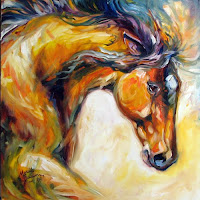
M. Baldwin-Determination;Equine Art Original

Determination; A Key Trait


Determination keeps us going. Determination makes us go further than our comfort zone. I am known as the lazy person who does not really try but I assure you once I put my mind to something I will give a 100% of my effort in completing this task. For example going into a soccer match can be tough and nerve-wracking especially for a goalkeeper. One simple mistake can cause your team to lose. Even though you may have let in a goal, in order to come back you have to have a determined attitude to win and who knows you might come back and win the game. After you have tried your best you have probably sensed one of life’s great mysteries. Success. Success is great but if you work hard to gain it, it feels even better. Even if you don’t win and you tried your best, it may hurt at first but you most likely realize that you gained something through this loss. This special something if practiced will make you an even player and person in general.